• Skip to main content

Passion4Social

  • Home
  • Our Services
    • All Accessibility Services
    • Accessibility Audit Services
    • Accessibility Overlay
    • Accessible Websites
    • Accessible Marketing and Comms
    • FAQs
  • Our Impact
    • Impact
    • Impact reports
    • Our story
    • Our team
    • Join our Board
  • Engage and Learn
    • Free webinars
    • Blog
    • Ebooks
  • Contact
You are here:
Engage and learn - Pay equality: challenges, reflections and opportunities
A mind the gap message painted on a railway platform

Pay equality: challenges, reflections and opportunities

August 5, 2024

Est min

In recent years, the UK, especially Scotland, has made significant strides in promoting pay equality between men and women.

However, challenges around wage discrimination stubbornly persist for other marginalised groups, not least people with disabilities and from ethnic minority backgrounds.

Let’s take time to reflect on the current situation and examine the ongoing impact of wage disparities on people’s social and economic prospects.

After all, we have a newly appointed Prime Minister at the helm of a resurgent Labour Party, so workers’ rights, especially those of historically neglected groups, should top his agenda.
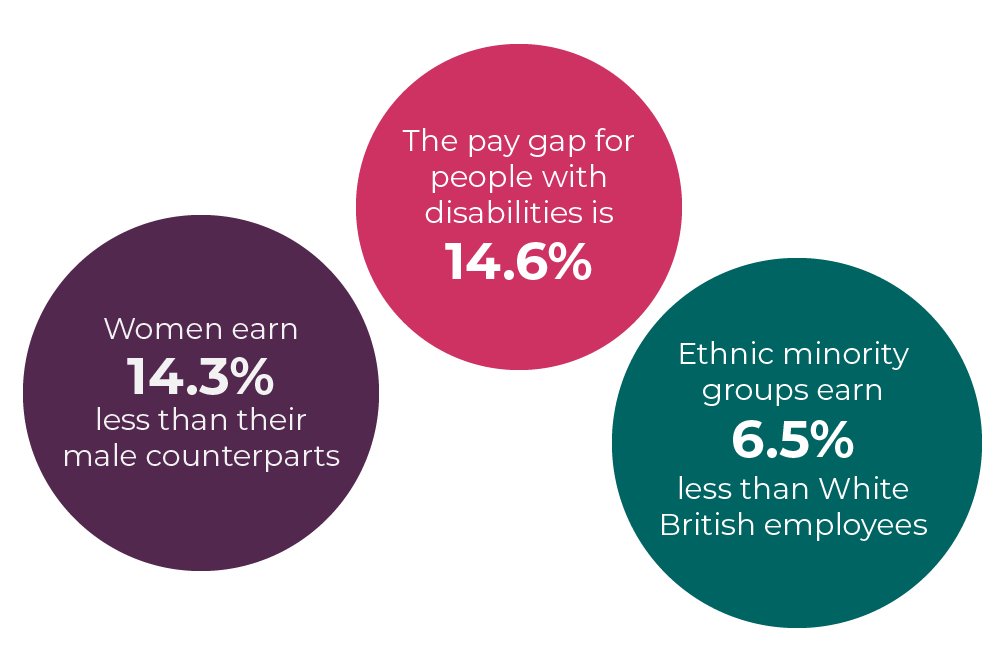
A purple circle on the left of the image which contains the text "women earn 14.3% less than their male counterparts", a pink circle in the middle which contains the text "the pay gap for people with disabilities is 14.6%" and a green circle on the right hand side which contains the text "ethnic minority groups earn 6.5% less than white British employees.

Salaries in focus

Pay equality has been a global concern for years, and neither Scotland nor the rest of the UK are an exception to the rule. 

Studies from the Office of National Statistics (ONS), amongst others, reveal women in the UK earn on average 14.3% less than their male counterparts (across both full-time and part-time employment).

This difference, or the “gender pay gap”, as you will probably know it better, reflects not just direct wage disparities but also broader structural and cultural issues within society.

More disappointing still is the pay gap for people with disabilities.

It currently sits at around 14.6%, meaning people with disabilities potentially earn £3,700 less a year than their non-disabled peers.

This is despite the higher cost of living if you are disabled, averaging an additional £581 per month. 

A 2021 report by the Equality and Human Rights Commission (EHRC) sheds further light on these inequalities: the average difference in employment rates, between disabled and non-disabled people, was 28.6% in 2019/2020, highlighting a substantial lack of access to employment opportunities which dramatically limits potential to earn.

Another gap that also draws attention is that of ethnic minorities: the pay gap between ethnic minority groups and White British employees is around 6.5%. This figure represents the difference in median hourly earnings between ethnic minority groups and their White British counterparts. 

However, the greater shock comes when analysing the specific scenario for the group in Scotland. The pay difference is approximately 7.2%, which is higher than the average difference across the UK as a whole.
A woman wearing a pink top looking at her laptop and smiling and to her left is a heading that says in Scotland large employers have to disclose wage data.

Government initiatives and legislation

Demonstrating its commitment to equal pay over the years, the Scottish government has implemented various policies and laws. 

One such piece of legislation requires large employers to disclose detailed wage data, enhancing transparency and accountability. 

Incentive programmes have also been introduced to encourage fair and equitable pay practices across all industries, including the Scottish Business Pledge, Fair Work First, Gender Pay Gap Reporting, and the Equal Pay Statement.

However, effective enforcement of these policies demands robust oversight, which is not always delivered consistently.

Neither does the government’s legislation on mandatory pay gap reporting include people with disabilities, those from ethnic minority backgrounds or other groups who remain on the edges of the labour market.

So there is ample room for improvement and a more targeted focus on closing all discriminatory pay gaps.
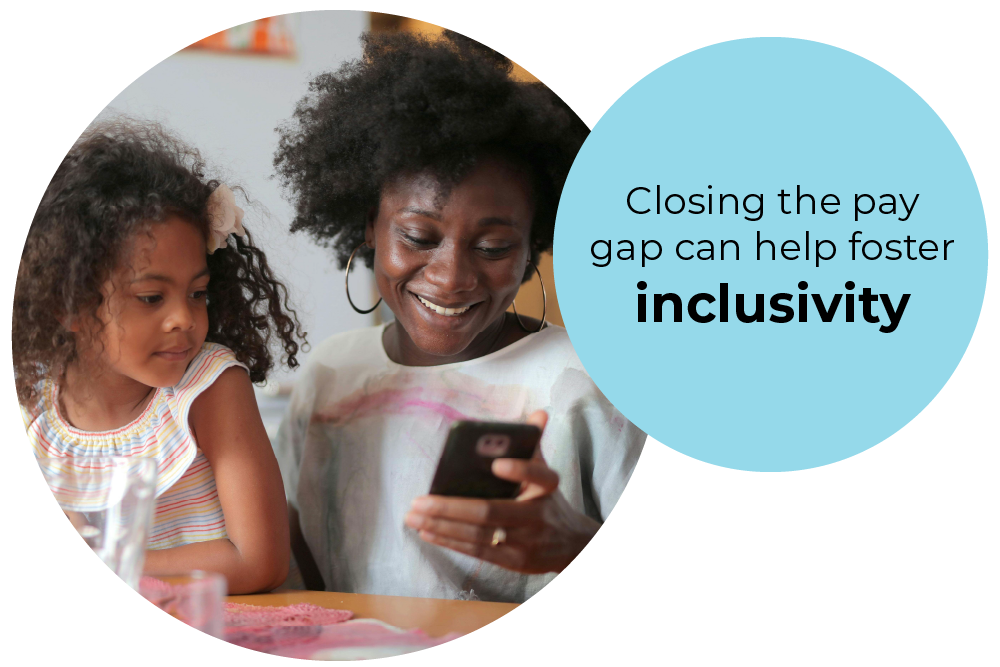
A mother sitting at a table with her child and the mother is looking at her phone and smiling there is a heading to the right that says closing the pay gap can help foster inclusivity.

The economic and social impact of eradicating wage discrimination

Pay equality is not solely a matter of social justice, it also brings significant and lasting economic implications. 

Studies show that closing the pay gap adds billions to the economy over time, stimulating consumption and fostering a more productive and inclusive work environment for everyone.

Of still greater importance, and on a more human level, achieving pay parity enhances the dignity of single mothers.

These women are often the only breadwinners in their households and play a pivotal role in the development of their children.

Similarly, it fosters respect and raises living standards for those with disabilities and from ethnic minority backgrounds, people who are disproportionately impacted by crises such as the Covid pandemic, and who often live below the poverty line through no fault of their own.

In terms of social justice, equal pay would promote that recognition of the potential of diverse talents, ideas and perspectives, which is still sadly lacking in many countries today.
A woman holding her face in her hands looking anxious and to her left there are 3 headings in coloured circles which are Ableism, Misogyny and Gender stereotypes. To her right are 3 headings in coloured circles which are Lack of wage transparency, Structural barriers and Racial discrimination.

Challenges remain

Over the past 20 years, pay disparities have undoubtedly diminished in Scotland. Yet, despite this progress, several challenges persist. 

Deep-seated gender stereotypes, misogyny, ableism, racial discrimination, lack of wage transparency, and structural barriers continue to contribute to wage discrimination.

Among other examples, we could be talking about:

  • Unhealthy corporate culture and social norms
  • Career opportunities being stifled or non-existent
  • Limited access to education, training or reskilling opportunities
  • Inadequate policies and implementation of pay equality 

These barriers are complex and intersectional, requiring multifaceted approaches if we are to truly effect meaningful change, and move closer towards the fair and equitable compensation we all deserve.
A woman wearing a purple top and blue jeans smiling and with her arms outstretched and to her right in a purple circle that contains an image of a balanced scale and below that text that reads "Public awareness and advocacy are integral to pay quality".

The road ahead

Public awareness and advocacy are integral to promoting pay equality.

We must keep the issue in the spotlight. It is the only way for important conversations to reach the right ears and be taken seriously.

So we need to truly harness the work of civil society organisations, equal rights advocacy groups, and the individual activists who have long been pushing for more robust legislative changes and effective implementation of existing policies.

As we continue to move forward, it is also crucial for both government and private sectors to commit to concrete and sustainable measures to close all pay gaps. 

This entails not only progressive policies but also a broader cultural shift that promotes equality and equity across all spheres of society.

Sadly, the recent King’s Speech, detailing the Labour Party’s plans for the coming months, was not the most convincing statement of intent.

It confirmed that a proposed bill to enshrine in law a “full right to equal pay for ethnic minorities and disabled people” would only be published in draft form.

Excluded people do not need yet more delays, they need simpler processes for bringing equal pay claims and for employers to be transparent about existing pay gaps.

We believe Scotland, for its part, is on the right path to fostering a culture of pay equality. 

Nevertheless, we need to see continued dialogue and advocacy if tangible change is to come to pass.

That means the MSPs and especially Scotland’s newly victorious Labour MPs keeping up pressure on the UK government to move at pace with its promised employment reforms.

By giving voice and visibility to progressive policies, community engagement, and ongoing commitment to economic and social justice, we can build a future where everyone has equal opportunities and recognition in the workplace.

Share via social media:

FacebookLinkedIn

You may also like...

Articles & Guides
Two smiling young people, lying on the floor in front of an open laptop computer, surrounded by books and school bags. An illustrative pencil graphic draws a line across the image from an accessibility icon drawn on the laptop lid. Passion4Social (logo).

Teaching digital accessibility early: The future of inclusive education

In this article: Why accessibility should be integrated in education...

Digital accessibility Accessibility Digital Inclusion
Read article Teaching digital accessibility early: The future of inclusive education
Articles & Guides
A dark grey, textured ground surface with a painted yellow accessibility icon. Painted yellow text reads: ‘Accessibility beyond websites.’ Passion4Social (logo).

Accessibility beyond websites: The rise of accessible everything

In today’s blog, you will read about: How digital accessibility...

Accessibility Digital Inclusion
Read article Accessibility beyond websites: The rise of accessible everything
Articles & Guides
Accessibility does not need to be dull – Quiz

Accessible Content Does Not Need to Be Dull

Who says accessible content has to be boring? Some people...

Quiz Accessibility Digital Inclusion
Read article Accessible Content Does Not Need to Be Dull
Articles & Guides
Amplifying disabled voices — Disability Pride Month, illustrated with a megaphone graphic

Digital Accessibility in Action: The Platforms, Creators and Advocates Amplifying Disabled Voices

As we tell anyone who will listen, creating accessible digital...

Accessibility Digital Inclusion
Read article Digital Accessibility in Action: The Platforms, Creators and Advocates Amplifying Disabled Voices
Upcoming free webinar
What you need to know about WCAG 3.0

What you need to know about WCAG 3.0

October 28, 2026 , 12 pm - 1 pm GMT

WCAG Accessibility Digital Inclusion
Register What you need to know about WCAG 3.0 (Opens in a new window)
Upcoming free webinar
A person holding an SLR camera up to their eye, looking through the lens and smiling against a teal background with a halftone pattern and purple circles. Text reads: ‘Accessible images: The art of alt text. Wednesday 25th of November, 12 pm GMT.’ Passion4Social (logo).

Accessible images: The art of alt text

November 25, 2026 , 12 pm - 1 pm GMT

Accessibility Digital Inclusion
Register Accessible images: The art of alt text (Opens in a new window)
Upcoming free webinar
A person with a prosthetic arm, posing confidently with their arms crossed and a warm smile against a pink background. Text reads: ‘Overlays vs lived experience users: Shortcut or setback? Wednesday 26th of August, 12 pm BST.’ Passion4Social (logo)

Overlays vs lived experience users: Shortcut or setback?

August 26, 2026 , 12 pm - 1 pm BST

Accessibility Digital Inclusion
Register Overlays vs lived experience users: Shortcut or setback? (Opens in a new window)
Articles & Guides
A person using a laptop computer at a wooden desk. Overlapping the laptop screen is a grey and white sad face graphic and a pink document graphic that reads: ‘PDF’. Passion4Social (logo).

When “Save as PDF” isn’t enough: Why accessible PDFs require knowledge, planning, testing and time  

In this article, you will discover: Polished-looking PDFs are not...

PDFs Accessibility
Read article When “Save as PDF” isn’t enough: Why accessible PDFs require knowledge, planning, testing and time  
Upcoming free webinar
A person holding a mobile phone and looking down at the screen with a serious expression against a teal background. Text reads: Digital poverty: Its impact and strategies for the future. Wednesday 23rd of September, 12 pm BST. With guests: Department for Work & Pensions, Lead Scotland. Passion4Social (logo)

Digital poverty: Its impact and strategies for the future

September 23, 2026 , 12 pm - 1 pm BST

Digital Inclusion
Register Digital poverty: Its impact and strategies for the future (Opens in a new window)
Articles & Guides
A laptop computer open on a desk. The screen displays the flag of the European Union with a white accessibility icon and ‘EAA’ at the centre. Passion4Social (logo).

The EAA one year on: What has really changed?

In this blog, you will read about: What has really...

Accessibility
Read article The EAA one year on: What has really changed?
Articles & Guides
A yellow background with a shopping cart. A white bar with a cursor reads: ‘Continue?’

The sales you never got to see and why digital accessibility could be the reason

How sales can be lost without ever appearing in your...

Accessibility
Read article The sales you never got to see and why digital accessibility could be the reason
Articles & Guides
When accessibility is an afterthought – Part 5" — hand placing a ballot in a box

When accessibility is an afterthought: Voting remains a postcode lottery for disabled voters

In  this blog, you will discover: How accessible voting exists...

Accessibility
Read article When accessibility is an afterthought: Voting remains a postcode lottery for disabled voters
Articles & Guides
Graphic with the text '10 quick accessibility wins' alongside a universal accessibility icon

Quick wins: 10 accessibility fixes you can implement now

In some circles, digital accessibility has a bad reputation, but...

Accessibility
Read article Quick wins: 10 accessibility fixes you can implement now
Accessibility Digital Inclusion
ebook cover for The European Accessibility Act

The European Accessibility Act

A practical guide to the European Accessibility Act, explaining what...
Download The European Accessibility Act
Articles & Guides
A man using a laptop is surrounded by eyes looking at his screen. There are location icons, speech bubbles and locks to symbolise online security. Lead Scotland and Passion4Social logos

Considering diversity in cyber security: Designing inclusive systems for disabled and neurodivergent users

Cyber security is no longer something that works away unobtrusively...
Cybersecurity
Read article Considering diversity in cyber security: Designing inclusive systems for disabled and neurodivergent users
Articles & Guides
A hand using a computer mouse and a white exclamation mark are outlined with green and black jagged shapes. Passion4Social (logo).

When a click becomes exhausting: The hidden mental health cost of inaccessible design

Inaccessible digital design carries a hidden mental health cost, moving...
Read article When a click becomes exhausting: The hidden mental health cost of inaccessible design
Articles & Guides
A person using a wheelchair while working on an open laptop computer against a teal background. Passion4Social (logo).

Technical expertise built on lived experience: Why our testers notice what others miss

Authentic accessibility goes beyond technical terminology or compliance with legal...

Read article Technical expertise built on lived experience: Why our testers notice what others miss
Articles & Guides
Illustrative depiction of neurodiversity showing colourful silhouettes of people and outlines of the human brain. Passion4Social (logo)

Exploring assistive tech in cyber security tools

With CYBERUK 2026 on the horizon, Net-Defence and Passion4Social CIC...

Accessibility Digital Inclusion
Read article Exploring assistive tech in cyber security tools
Articles & Guides
A group of three diverse women gathered around an open laptop computer, looking down at the screen and smiling. Passion4Social (logo)

Who is being left behind? The entry point is digital

Digital inaccessibility is a significant structural barrier that widens the...

Accessibility Digital Inclusion
Read article Who is being left behind? The entry point is digital
Articles & Guides
The torso of a person wearing a stethoscope around their neck and green medical scrubs. Bold black text against a yellow background reads: Patients pay the price

When accessibility is an afterthought: Patients pay the price

Government organisations and institutions spend millions on cybersecurity, protecting their...

Accessibility
Read article When accessibility is an afterthought: Patients pay the price

Ready to take action?

The sooner you start on your accessibility journey, the sooner everyone can benefit from your inclusive online presence.

Start your accessibility journey
People and planet first logo with text underneath stating Verified social enterprise
Living hours employer logo
Cyber essentials certified logo
RNIB visibly better logo
Disability confident employer logo
Living wage employer logo
Edinburgh social enterprise network logo
Scottish union of supported employment SUSE logo
social firms Scotland logo
The good stuff community Edinburgh logo
National lottery community fund logo
Gsen Glasgow Social Enterprise Network logo
p4s_section-3_logo-ses

Back to top

Let's Connect

01506 353625 enquiries@passion4social.com

Copyright © 2025 Passion4Social

Socials

Subscribe
  • Privacy Policy
  • Terms and conditions
  • Sitemap
  • Accessibility Statement
Manage Cookie Consent
To provide the best experiences, we use technologies like cookies to store and/or access device information. Consenting to these technologies will allow us to process data such as browsing behaviour or unique IDs on this site. Not consenting or withdrawing consent, may adversely affect certain features and functions.
Functional Always active
The technical storage or access is strictly necessary for the legitimate purpose of enabling the use of a specific service explicitly requested by the subscriber or user, or for the sole purpose of carrying out the transmission of a communication over an electronic communications network.
Preferences
The technical storage or access is necessary for the legitimate purpose of storing preferences that are not requested by the subscriber or user.
Statistics
The technical storage or access that is used exclusively for statistical purposes. The technical storage or access that is used exclusively for anonymous statistical purposes. Without a subpoena, voluntary compliance on the part of your Internet Service Provider, or additional records from a third party, information stored or retrieved for this purpose alone cannot usually be used to identify you.
Marketing
The technical storage or access is required to create user profiles to send advertising, or to track the user on a website or across several websites for similar marketing purposes.
  • Manage options
  • Manage services
  • Manage {vendor_count} vendors
  • Read more about these purposes
View preferences
  • {title}
  • {title}
  • {title}