




July 7, 2025

Est 6 min
Who would have thought that in the year 2025, conversations about disability would still largely revolve around welfare support and vulnerability?
Yes, as so many organisations tell us with pride that they live the values of diversity, equity and inclusion, disabled people are still seen as economic burdens, rather than innovators or drivers of growth.
This is a false, harmful narrative.
One that the current government seems determined to reinforce with its overt attacks on the very support systems that enable people to find and stay in employment.
One that will continue to cost the country dearly amidst the financial uncertainties we are experiencing.
Yet, embracing this one truth could help reverse the turmoil caused by COVID-19, Brexit, and the cost-of-living crisis: when you empower people with disabilities to reach their potential, the whole economy thrives.
 Smart economics
Disability inclusion in our workplaces is more than simply ‘doing the right thing’.
It is a smart economic strategy.
Around 16 million people in the UK live with a disability (almost 22% of the population), making this one of the largest untapped pools of talent, unique skill sets and market potential in the country.
It has been proven that diverse teams are more innovative and productive, and people with disabilities especially bring unique problem-solving skills to the workplace.
They bring lived experience born from navigating a world not always designed with them in mind, fuelling creativity, adaptability, and resilience.
These are qualities any forward-thinking business would value.
Neither is inclusion just about creating employment opportunities: people with disabilities represent a huge target market.
If people earn a fair day’s wage for a fair day’s work, they have higher disposable income and are willing to spend it with brands that clearly show their commitment to inclusion
Don’t just take our word for it; the statistics speak for themselves:
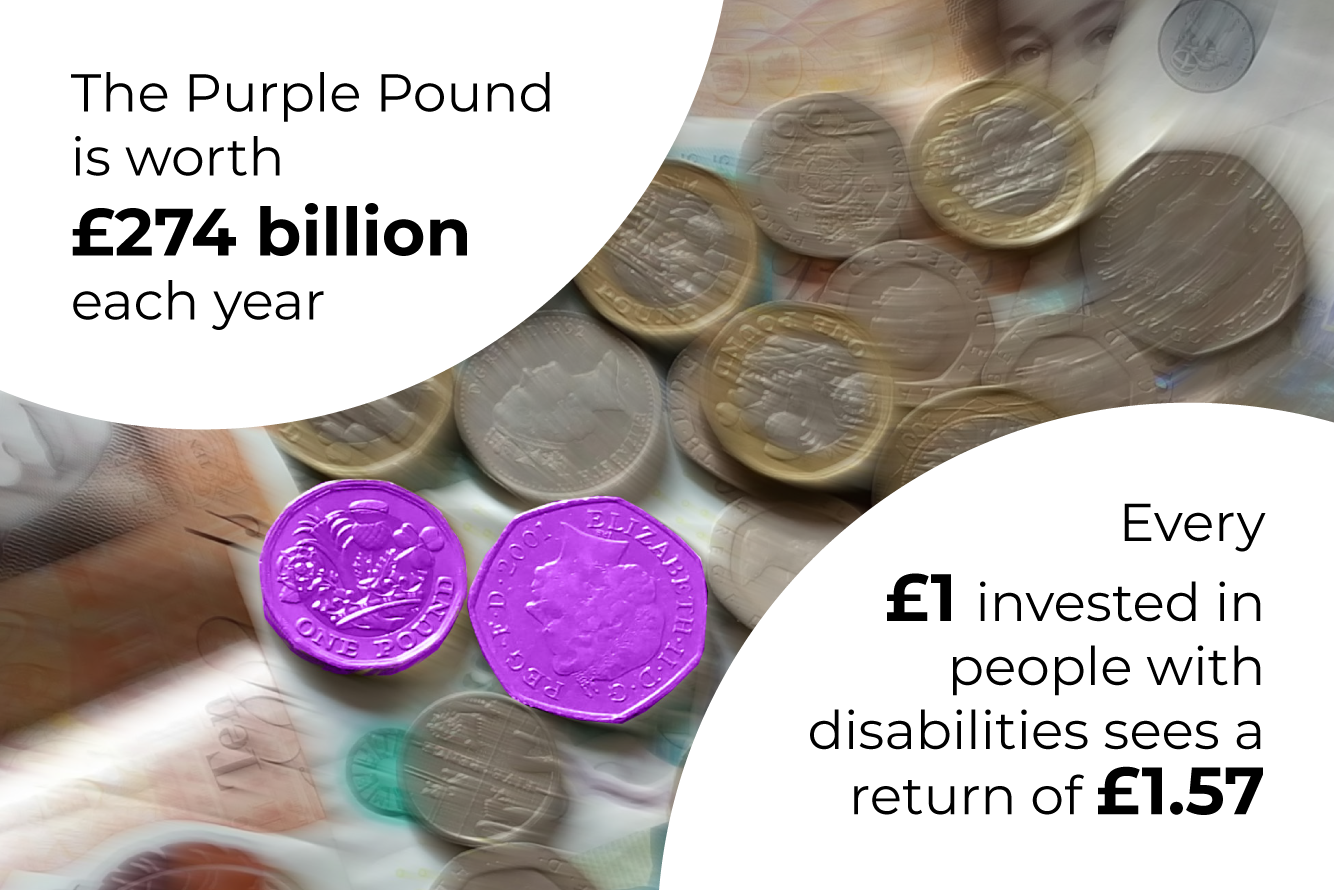
- The Purple Pound (the spending power of people with disabilities and their families) is worth £274 billion to the economy each year.
- 86% of shoppers with access needs say they would spend more if there were fewer barriers in their path.
- Research shows that for every £1 invested in people with disabilities, the UK economy sees a return of £1.57.
In short, when people with disabilities are included in the workforce, businesses and ultimately, society as a whole benefit.
 Mind the gap
In spite of this clear economic contribution, an overwhelming number of people still experience huge disparities in accessing employment opportunities and fair incomes compared to their non-disabled counterparts. Again, the statistics tell their own story:
- Just five million people with disabilities are employed.
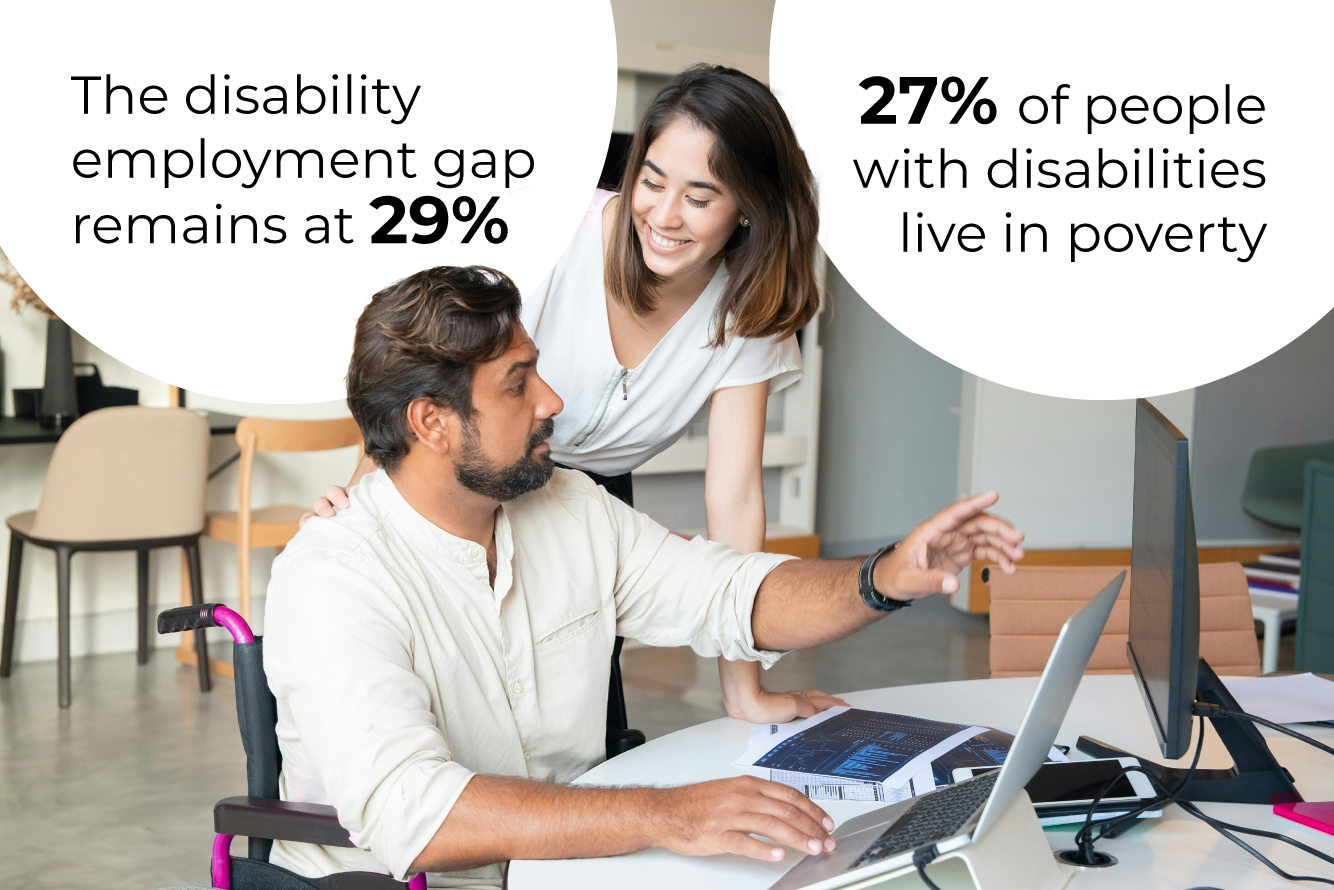
- The disability employment gap remains static at 29%.
- People with disabilities are almost twice as likely to be unemployed as non-disabled people, and 3 times as likely to be economically inactive.
- After housing costs, 27% of people with disabilities live in poverty, compared to 19% of non-disabled people.
 Breaking down practical barriers empowers everyone
Systemic and physical barriers continue to lock people out of opportunities to work and limit their ability to participate in society.
They not only ensure that many people struggle to afford life’s basics; but they also represent lost growth.
Career support, for example, is often a postcode lottery. Many job seekers can only access generic advice that does not take account of their specific needs, or they are steered towards posts completely unsuited to their experience and skill set.
We need to see a joined-up, consistent approach that opens up clear support pathways, from secondary education onwards. That looks like easy access to high-quality guidance, training opportunities, assistive technologies and mentoring in every corner of the country.
Furthermore, schemes like Access to Work, which were designed to provide reasonable adjustments and assistive equipment, are utterly failing to meet the needs of people who do succeed in finding employment.
They are poorly publicised, underfunded, and painfully hampered by the needless bureaucracy that seems to invade every aspect of our daily lives. Increased resourcing rather than real-terms cuts, less red tape, and clearer communication for both employers and employees have to be the order of the day for these schemes going forward.
When they do work, they harness people’s potential. As it is, too many talents are being lost.
Legal loopholes and a lack of enforcement also mean some employers continue to treat flexibility as optional or take on disabled staff under exploitative conditions.
Without robust legal frameworks and an accessible process for redress, disabled workers remain at high risk of being used as cheap labour.
The right to flexible working from day one and mandatory disability pay gap reporting should be on the government’s to-do list if we are to truly send the message that disabled workers’ time and skills are just as valuable as anyone else’s.
Investment in inclusive infrastructure and assistive tech also remains an issue.
Imagine finding your dream job, only to get to the front door of the building and discover there is no step-free access or lift.
Doesn’t it seem like a grossly unfair, not to mention absurd, reason for losing out on a potentially life-changing opportunity?
Many employers still view investment in accessible infrastructure as an unnecessary, costly exercise, but the truth is that the returns are worth every penny.
Besides, making improvements benefits everyone, not just disabled workers.
 Changing the narrative for a thriving economy
So we have looked at the practicalities, but the biggest shift we need to make is cultural. People with disabilities are too often seen as objects of sympathy, rather than the assets they are. That outdated misconception is holding the economy back.
It is time to tell a different story: one that places disabled people’s skills, ideas, and economic value at the heart of our collective success.
Employers should be proud to champion inclusive hiring, not just because it’s the right thing to do, but because it’s the smart thing to do.
People with disabilities can be leaders, problem-solvers, and drivers of economic prosperity, but only if we start investing in their potential.
It’s time to see our policies and narratives match their ambitions!
Share via social media:


You may also like...

Teaching digital accessibility early: The future of inclusive education
In this article: Why accessibility should be integrated in education...

Accessibility beyond websites: The rise of accessible everything
In today’s blog, you will read about: How digital accessibility...

Accessible Content Does Not Need to Be Dull
Who says accessible content has to be boring? Some people...

Digital Accessibility in Action: The Platforms, Creators and Advocates Amplifying Disabled Voices
As we tell anyone who will listen, creating accessible digital...

What you need to know about WCAG 3.0
October 28, 2026 , 12 pm - 1 pm GMT

Accessible images: The art of alt text
November 25, 2026 , 12 pm - 1 pm GMT

Overlays vs lived experience users: Shortcut or setback?
August 26, 2026 , 12 pm - 1 pm BST

When “Save as PDF” isn’t enough: Why accessible PDFs require knowledge, planning, testing and time
In this article, you will discover: Polished-looking PDFs are not...

Digital poverty: Its impact and strategies for the future
September 23, 2026 , 12 pm - 1 pm BST

The EAA one year on: What has really changed?
In this blog, you will read about: What has really...

The sales you never got to see and why digital accessibility could be the reason
How sales can be lost without ever appearing in your...

When accessibility is an afterthought: Voting remains a postcode lottery for disabled voters
In this blog, you will discover: How accessible voting exists...

Quick wins: 10 accessibility fixes you can implement now
In some circles, digital accessibility has a bad reputation, but...

The European Accessibility Act
A practical guide to the European Accessibility Act, explaining what...
Considering diversity in cyber security: Designing inclusive systems for disabled and neurodivergent users
Cyber security is no longer something that works away unobtrusively...

When a click becomes exhausting: The hidden mental health cost of inaccessible design
Inaccessible digital design carries a hidden mental health cost, moving...
Technical expertise built on lived experience: Why our testers notice what others miss
Authentic accessibility goes beyond technical terminology or compliance with legal...

Exploring assistive tech in cyber security tools
With CYBERUK 2026 on the horizon, Net-Defence and Passion4Social CIC...

Who is being left behind? The entry point is digital
Digital inaccessibility is a significant structural barrier that widens the...

When accessibility is an afterthought: Patients pay the price
Government organisations and institutions spend millions on cybersecurity, protecting their...


